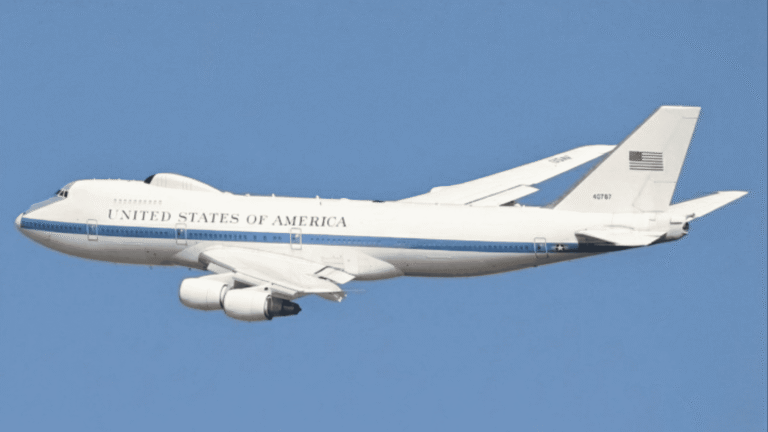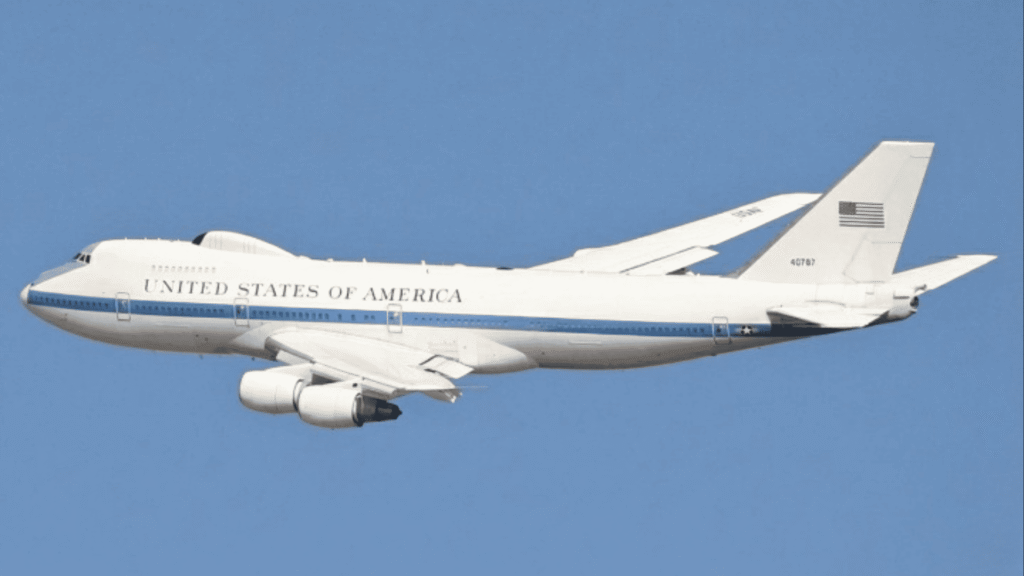
The United States’ highly secretive Doomsday Plane, officially known as the Boeing E-4B Nightwatch, has drawn global attention after being spotted flying near Washington, D.C., and later landing in Los Angeles. The rare public movement of the aircraft has sparked widespread curiosity and online speculation due to its unique role in America’s nuclear and national security strategy.
Rare Flight Sparks Public Curiosity
According to publicly available flight-tracking data, the E-4B aircraft departed from Offutt Air Force Base in Nebraska on January 6, flew to Camp Springs, Maryland, near the US capital, and later landed at Los Angeles International Airport. Videos of the landing quickly went viral on social media platforms.
The aircraft is designed to operate discreetly, and its flights are usually kept away from public attention. This unusual visibility is the main reason why the movement raised eyebrows.
US media later reported that Defense Secretary Pete Hegseth was onboard the aircraft, though the Pentagon has not officially explained why the E-4B was used instead of a standard government plane.
What Exactly Is the “Doomsday Plane”?
The E-4B Nightwatch functions as the National Airborne Operations Center (NAOC)—a flying command headquarters meant to keep the US government operational during extreme emergencies, including
- Nuclear war
- Large-scale military attacks
- Destruction of ground-based command centres
Because of this role, it is often called the “Flying Pentagon.”
Built on a heavily modified Boeing 747-200, the aircraft is specially hardened to withstand:
- Electromagnetic pulse (EMP) attacks
- Nuclear and thermal radiation
- Cyber and communications disruptions
It plays a critical role in the US Nuclear Command, Control, and Communications (NC3) system.
Key Capabilities of the E-4B Nightwatch
- Maximum endurance: Around 12 hours (extendable with in-flight refuelling)
- Passenger capacity: Up to 111 personnel
- Operating altitude: Over 30,000 feet
- Fleet size: Only four aircraft exist
- Cost: Approximately $223 million per aircraft
At least one E-4B is kept on continuous alert at all times, ready to deploy within minutes.
Inside the Flying Command Centre
The aircraft’s interior is divided into multiple functional zones, including:
- Command and control rooms
- Conference and briefing areas
- Secure communications hubs
- Operations floor
- Rest areas for crew and officials
Advanced satellite and radio systems allow global communication with military units, nuclear forces, and government leadership—even if all ground infrastructure is destroyed.
Service History and Real-World Use
The E-4B fleet entered service in the early 1980s. Despite its intimidating nickname, the aircraft has been used in a real emergency only once, following the September 11, 2001, terror attacks, to ensure continuity of government.
While training missions occur regularly, public sightings are extremely rare, which is why the latest multi-city flight attracted so much attention.
Why This Flight Is Being Closely Watched
The aircraft’s appearance comes at a time of heightened global tension, including escalating US military operations and geopolitical developments in Latin America.
US officials have not linked the flight to any specific international event. However, the timing has fueled speculation online, given the E-4B’s role in worst-case national security scenarios.
What It Ultimately Signals
Whether this mission was related to routine logistics, senior leadership travel, enhanced security precautions, or strategic signaling remains unknown. But the Doomsday Plane exists for moments when uncertainty, risk, and preparedness dominate global affairs.
Whenever the E-4B appears in public view, it inevitably raises the same silent question: not what has already happened, but what the US government may be preparing for.
About the Author