Aravalli Hills news showing protests and environmental concerns after Supreme Court stay
The Aravalli Hills, one of India’s oldest mountain ranges, are once again at the center of a nationwide debate. Recent developments, including a Supreme Court stay on its earlier order, growing public protests, and official clarifications from the government, have brought renewed attention to the future of the fragile ecosystem. The issue now goes beyond legal interpretation and raises serious environmental and policy concerns across several states.
What Is the Latest Supreme Court Decision?
In late December 2025, the Supreme Court of India put its earlier order on the definition of the Aravalli Hills on hold. The court had previously ruled in November that landforms rising 100 meters or more above the surrounding terrain would be classified as part of the Aravalli range.
However, the decision triggered widespread criticism from environmental experts, who argued that such a height-based definition could exclude a large portion of the Aravalli landscape. Responding to these concerns, the apex court stayed its earlier judgment and ordered the formation of a high-powered expert committee to reassess the definition using scientific parameters. The matter is scheduled for further hearing in January 2026.
Why Did the Definition Trigger Controversy?
Environmentalists and researchers have warned that most Aravalli formations are not very tall but still play a crucial ecological role. Many ridges, slopes, and scrublands fall below the 100-meter mark yet contribute significantly to groundwater recharge, biodiversity protection, and the prevention of desertification.
Critics fear that excluding these areas from formal protection could make them vulnerable to mining, construction, and commercial activity. In response, the Ministry of Environment, Forest, and Climate Change clarified that the definition applies only to mining regulation and stated that no new mining leases would be granted until a scientific framework is finalized.
Protests and Public Response
The controversy has sparked protests in multiple states. Students, environmental groups, and local communities have taken to the streets under the banner #SaveAravalli, demanding stronger and broader legal safeguards for the entire range.
In Delhi, university students organized marches highlighting the long-term environmental risks of narrowing the definition. Similar protests were reported in parts of Rajasthan, where local residents expressed concern that reclassification could lead to increased mining and real estate activity in sensitive zones.
Political and Institutional Reactions
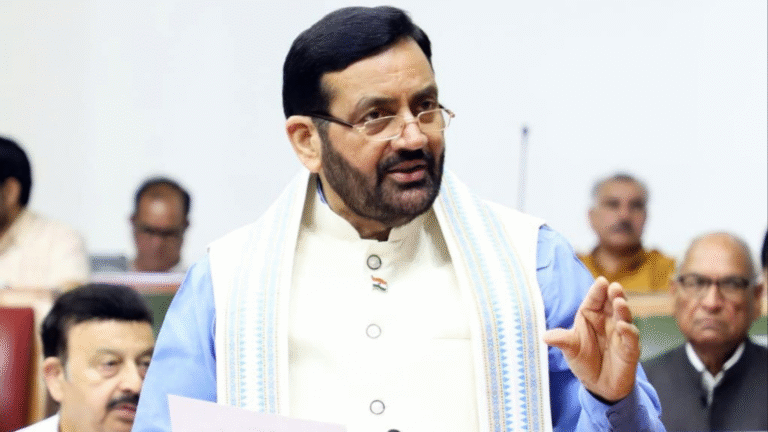
Political leaders and public representatives have also weighed in on the issue. Some welcomed the Supreme Court’s decision to reconsider the definition, emphasizing that environmental protection should take precedence over commercial interests.
At the same time, government officials have maintained that the revised framework aims to curb illegal mining rather than weaken safeguards. Authorities have stated that a large portion of the Aravalli region will continue to remain protected under existing laws, pending the committee’s recommendations.
Ecological Importance of the Aravalli Hills
Stretching across Delhi, Haryana, Rajasthan, and Gujarat, the Aravalli Hills serve as a critical ecological barrier in northern and western India. The range helps block dust-laden winds from the Thar Desert, supports groundwater systems, and sustains a diverse range of plant and animal life.
Several scientific studies suggest that focusing solely on elevation does not accurately reflect the ecological value of the Aravalli ecosystem. Conservationists argue that protection policies must consider the entire landscape rather than isolated measurements.
Illegal Mining Remains a Concern
Despite court orders and regulatory measures, reports indicate that illegal mining continues in parts of the Aravalli region. Thousands of cases have been registered over the past two decades, with environmental activists blaming weak enforcement at the local level.
Unregulated extraction has caused long-term damage to hills, forests, and water systems, further intensifying calls for stricter monitoring and accountability.
What Lies Ahead?
The formation of the expert committee marks a critical step in the ongoing legal and environmental process. Its findings are expected to play a key role in shaping future policies related to mining, conservation, and land use in the Aravalli region.
As stakeholders await the Supreme Court’s next hearing, the outcome is likely to influence environmental governance far beyond the Aravalli Hills.
Conclusion
The Aravalli Hills debate highlights the complex balance between development and environmental protection in India. With the Supreme Court revisiting its earlier stance and public pressure mounting, the focus has shifted toward a more scientific and inclusive approach. The decisions taken in the coming months will be crucial in determining how one of India’s most vital natural landscapes is preserved for future generations.
About the Author