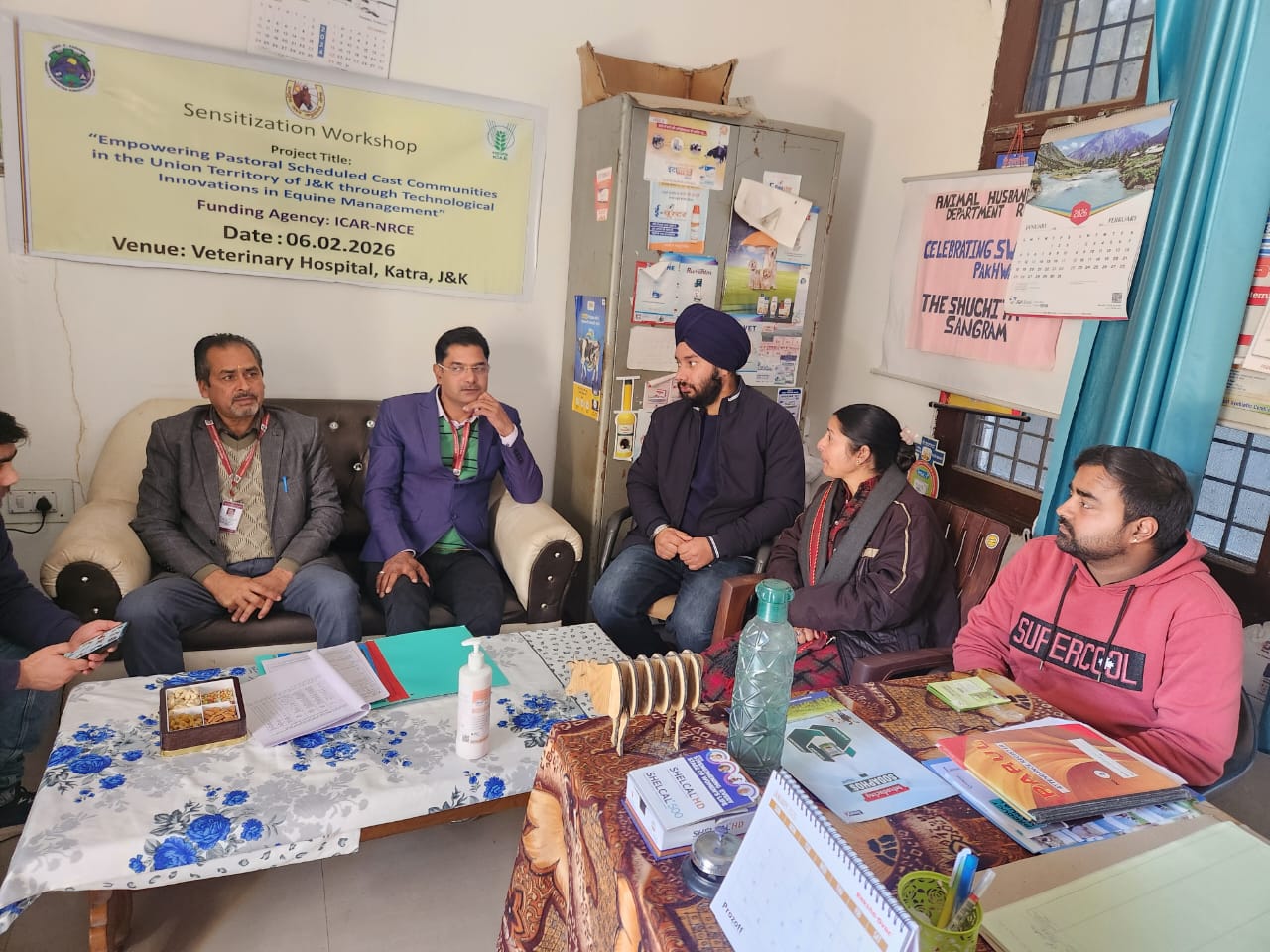
Veterinary officers attend the SKUAST Jammu equine management workshop in Katra.
The SKUAST Jammu equine management workshop was organised at the Veterinary Hospital in Katra to strengthen equine health services and improve livelihood opportunities for pastoral communities. The one-day sensitisation programme was conducted under an ICAR–NRCE sponsored project focusing on technological innovations in equine management.
Veterinary officers from different areas of Reasi district participated in the workshop. The programme aimed to familiarise field-level officials with the project’s objectives and planned activities, ensuring effective implementation at the grassroots level.
Background of the project
The SKUAST Jammu equine management workshop is part of a specialised project titled “Empowering pastoral SC communities through technological innovations in equine management.” Equines such as horses and mules play a vital role in the economy of Jammu and Kashmir, particularly in pilgrimage and hilly regions like Katra.
In these areas, equines are closely linked to tourism and transport-based livelihoods. However, limited access to modern veterinary care, disease prevention systems, and scientific management practices has often affected equine health and productivity. The project seeks to address these gaps through structured interventions.
Objectives of the workshop
The primary objective of the workshop was to sensitise veterinary officers about equine health improvement strategies under the project. The focus remained on disease management, preventive care, nutrition, and adoption of appropriate technologies for better equine welfare.
The programme was organised by the Faculty of Veterinary Sciences and Animal Husbandry, SKUAST Jammu, under the guidance of Prof. B. N. Tripathi, Hon’ble Vice-Chancellor of the university. He highlighted the importance of coordinated efforts between academic institutions and government departments for sustainable animal health development.
Key discussions and official inputs
At the beginning of the session, Dr Pankaj Goswami, Principal Investigator of the project, welcomed the participants and presented a detailed overview of the project roadmap. He explained how scientific research and field-level veterinary services would be integrated to deliver measurable outcomes.
Dr Ravi K. Kaith, Chief Animal Husbandry Officer (CAHO), Reasi, appreciated the initiative taken by SKUAST Jammu. He assured full departmental support for smooth execution of project activities and stressed the need for capacity building among veterinary staff.
Participation of experts and field officers
The SKUAST Jammu equine management workshop featured in-depth discussions led by Co-Principal Investigators Dr Hansraj Bhardwaj and Dr Nazam Khan. The experts interacted with veterinary officers on region-specific challenges and practical solutions for equine health improvement.
Veterinary officers who participated in the workshop included Dr Shivani Thapa (VAS, Banganga), Dr Prabjot Singh (VAS, Katra), Dr Anil Kumar (VAS, Panthal), Dr Amandeep Singh (VAS, Bagdhar), and Dr Vishav (VAS, MVU Reasi). Their field experience contributed to meaningful and solution-oriented deliberations.
Support from district administration
The successful conduct of the workshop was made possible with the support of the district administration. The SKUAST Jammu team acknowledged the cooperation extended by Ms Nidhi Malik, IAS, Deputy Commissioner, Reasi. Administrative facilitation helped ensure effective coordination and participation.
Such collaboration between academic institutions, government departments, and district authorities is considered essential for the long-term success of development-focused projects.
Closing session
The workshop concluded with a formal vote of thanks delivered by the Principal Investigator. The organisers reiterated their commitment to continuous engagement with veterinary officers and equine rearers during the project period.
What impact will this news have?
The SKUAST Jammu equine management workshop is expected to significantly improve equine health services in Reasi district. Enhanced technical knowledge among veterinary officers will lead to better disease prevention and animal welfare. Over time, this initiative may help stabilise incomes and strengthen livelihood security for pastoral SC communities dependent on equine-based activities.
Conclusion
The workshop organised at Katra marks an important step toward strengthening equine management practices in Jammu and Kashmir. Through collaboration between SKUAST Jammu, ICAR, the animal husbandry department, and district administration, the project has the potential to deliver lasting benefits for equine health and community empowerment.
About the Author